
A thriving community garden runs on more than soil and seeds. Behind every season there is a pile of admin: who has which plot, who is waiting for one, who has paid, and who showed up for the last workday. When that information lives in a mix of notebooks, email threads and one volunteer’s memory, things slip through the cracks. Here is a practical way to organize the four areas that cause the most headaches: plots, waitlists, dues and volunteers.
1. Map and track your plots
Start with a single list of every plot: its number, size, location and current status. Useful statuses include vacant, assigned, offered, under maintenance, reserved and community (shared) plots. Keeping the status current means you always know what is open before someone asks.
A visual map helps even more. When new members can see where their plot sits relative to paths, water and common beds, there are fewer questions on assignment day.
2. Keep a fair, transparent waiting list
Popular gardens often have more interested gardeners than plots. A clear waitlist policy, written down and shared, prevents disputes. Decide how you rank applicants (for example, by date added) and stick to it.
- Record each applicant’s contact details and the date they joined the list
- Note when a plot is offered and when the person responds
- Have a human coordinator make every offer decision, following your policy
3. Collect dues without the confusion
Dues fund water, tools and repairs, but chasing payments is nobody’s favorite job. Set a price list (for example, by plot size), decide whether you offer sliding-scale discounts, and track what each member owes and has paid. Give every payment a receipt, and review who is overdue on a regular schedule.
4. Organize volunteers and workdays
Many gardens ask members to contribute a set number of volunteer hours. Track hours against what is required, schedule workdays in advance, and use a sign-in sheet so hours are recorded on the spot rather than reconstructed later.
5. Standardize your paperwork
Consistent forms save coordinators time every season. A good set usually includes:
- Member registration and plot assignment or agreement
- Waitlist and renewal forms
- Garden rules
- Volunteer sign-in sheets
- Incident reports
- Meeting minutes
- Payment receipts
Agreements, waivers and notices should be reviewed locally before you use them, since rules vary by place and organization.
6. Plan the season rollover
At the end of each season, renew returning members, release abandoned plots, offer openings to the waitlist and produce a short summary of the year: occupancy, dues collected, volunteer hours and harvest or donation totals. That summary is useful for your committee, your landlord or your sponsors.
7. Protect members’ privacy
Keep personal contact details in one place with limited access, and share only what is needed, such as plot numbers and names, in public-facing lists.
8. Track the rest of the garden, too
Once plots, people and money are under control, it becomes easier to keep an eye on everything else that keeps a garden running. A simple log of maintenance jobs (a broken hose bib, a fence that needs mending) stops the same problem from being reported five times. A tools and supplies list shows what you own, what is on loan and what needs replacing. An events calendar and an expenses-versus-budget sheet help your committee plan ahead instead of reacting. If your garden donates produce, recording planting and harvest totals makes it easy to report what you grew and gave away at the end of the season.
You don’t need to set all of this up at once. Start with whichever area causes the most questions from members, get it working for one season, then add the next.
A ready-made toolkit: RootRoster
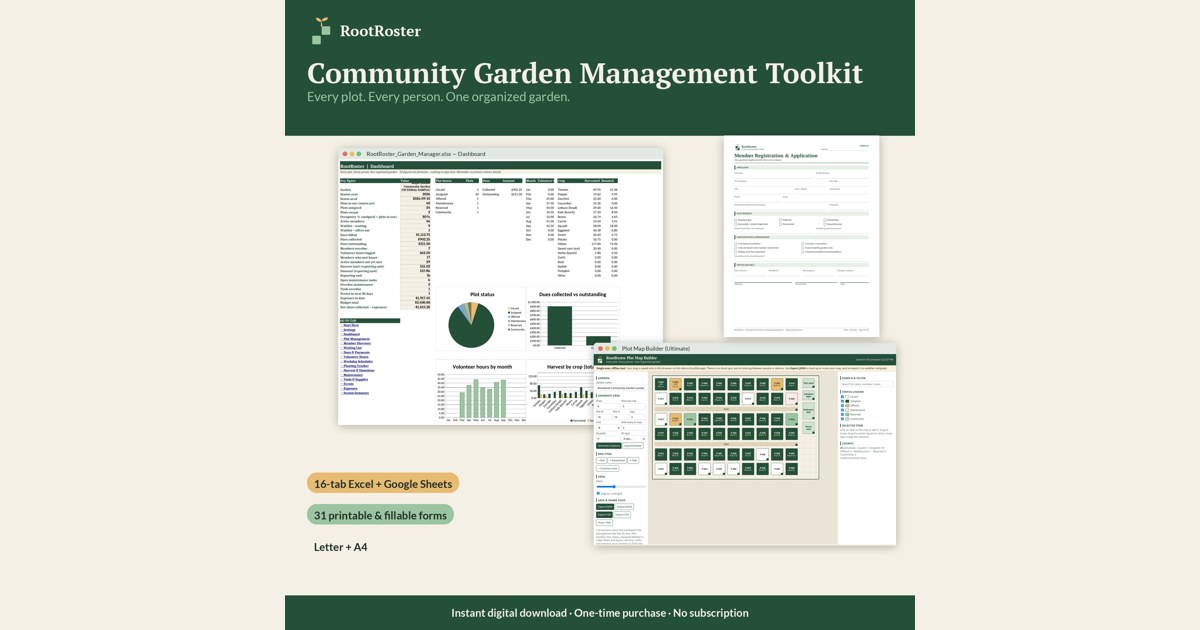
If you would rather not build all of this from scratch, RootRoster is a Community Garden Management Toolkit made for volunteer coordinators. It is a one-time purchase with no subscription, account or cloud service, and your data stays on your device or in your own Google account.
- Starter ($9.99): 24 administrative forms in printable and fillable versions, US Letter and A4.
- Complete ($24.99): a 16-tab Excel workbook with a Google Sheets version, covering up to 150 plots and 300 members, a policy-ranked waiting list, dues with sliding-scale discounts and overdue flags, volunteer hours, workdays, plantings, harvests, expenses and a Season Summary, plus the 24 forms and setup guides.
- Ultimate ($39.99): everything in Complete, 31 forms, an offline drag-and-drop Plot Map Builder with six color-coded statuses, and training guides for coordinators and volunteers.
Note that the workbook uses ordinary formulas with no macros, so it won’t send emails or reminders for you. It keeps everything in one organized place so you can act quickly.
However you set it up, the goal is the same: every plot, every person, one organized garden. Explore the RootRoster kits.