
You can be fully ready to work and still have an empty calendar. The skills are there; the customers are not. Posting on social media and waiting rarely fills that gap, and cold outreach feels awkward when you do not have a plan for it.
The first ten customers are the hardest to get, because nobody has heard of you yet. This post lays out a six-step plan for new service businesses, such as cleaning, tutoring, design, repairs, beauty, coaching, photography or bookkeeping, and for freelancers restarting after a slow period.
Step 1: Define Your Ideal First Customer
A clear target makes every message easier to write. Instead of “anyone who needs help,” describe one type of customer you can serve well right now. Answer four questions:
- Who are they, and where do they live or work?
- What specific problem do you solve for them?
- What do they currently do instead of hiring you?
- Where do they look for help?
That third question is easy to skip and very useful. If they currently do it themselves, your message is about saving time. If they currently use someone else, your message is about what you do differently. If they do nothing, your message is about the cost of leaving the problem alone.
Step 2: Package a Simple Starter Offer
Vague services with no clear price are hard to say yes to. A clearly named starter package removes the uncertainty. Keep it small enough that you can deliver it very well.
- Name the package and list exactly what is included
- Set one price and say how long it takes
- Decide what is not included
- Add a clear next step, such as booking a call
A starter offer is not a discount
It is tempting to cut your price to win early customers. A better approach is a smaller, well-defined first job that shows your quality, at a fair price. A “one-closet reset” or a “single-room deep clean” is easier to buy than a vague promise of “organizing” or “cleaning,” and it gives the customer a low-risk way to try you.
Step 3: Build Your List of 100 Contacts
Write down everyone who might need your service or knows someone who does. Aim for 100 names. The size of the list matters, because most people on it will not need you right now, but many of them know someone who might.
Look through these groups:
- Your personal network: friends, family and neighbors
- Past colleagues and former clients
- Community, school and faith groups
- Complementary businesses that could refer you
- Local online groups where self-promotion is allowed
Complementary businesses deserve special attention. A house cleaner and a real estate agent, a tutor and a children’s activity center, a photographer and an event planner: each sees customers the other needs. One good referral partner can send more work than dozens of posts.
Step 4: Reach Out With Short, Honest Messages
Personal messages work better than broadcast posts. A good outreach message does three things: says what you started, names who you help, and asks a small question. It never pressures.
Here is the kind of message the guide recommends:
“I just started a home organizing service for busy families. If you or anyone you know wants help with a closet or garage, I’d be glad to talk.”
Notice that it does not ask the person to buy anything. It asks whether they or someone they know could use the help, which is easy to answer honestly.
- Message about 10 people per day
- Mention one specific way you can help
- Ask if they know anyone who needs it
- Log every message and every reply
Ten a day is small enough to keep up and adds up quickly. Logging matters because it is the only way to know who to follow up with.
Step 5: Follow Up and Close the Booking
Most replies need a follow-up, and many interested people simply forget to answer. Not following up is one of the most common reasons new businesses stay quiet.
- If there is no reply, follow up once after 3 to 5 days
- Answer questions quickly
- Send a written quote or confirmation with the price and scope
- Offer two specific times instead of asking “when works for you?”
- Take a deposit if it makes sense for your service
Offering two specific times turns an open-ended question into an easy choice. If booking still takes too much back-and-forth, our guide How to Set Up a Simple Business Booking System shows how to make it simpler.
Step 6: Turn Customers Into Referrals and Reviews
A satisfied customer is your best marketing, but most will not think to recommend you unless you ask. Deliver great work first, then make the request specific and easy.
- Ask for a review within a few days of finishing, while the result is fresh
- Ask who else might benefit from your service
- Send a thank-you note
- Track which source brought in each customer
Tracking sources tells you where to spend your time next. If three of your first ten customers came from one referral partner, that relationship deserves more attention than another week of posting. A simple printed thank-you card or a small stack of business cards for happy customers to pass along also helps keep your name in circulation.
Common Mistakes to Avoid
- Waiting for customers to find a new business
- Sending mass messages instead of personal ones
- Not following up
- Offering vague services with no clear price
- Forgetting to ask for referrals
Just getting started and working with a small budget? Start a Business With $500 or Less covers testing your idea and planning spending before you launch.
Get the Full First Customers Guide
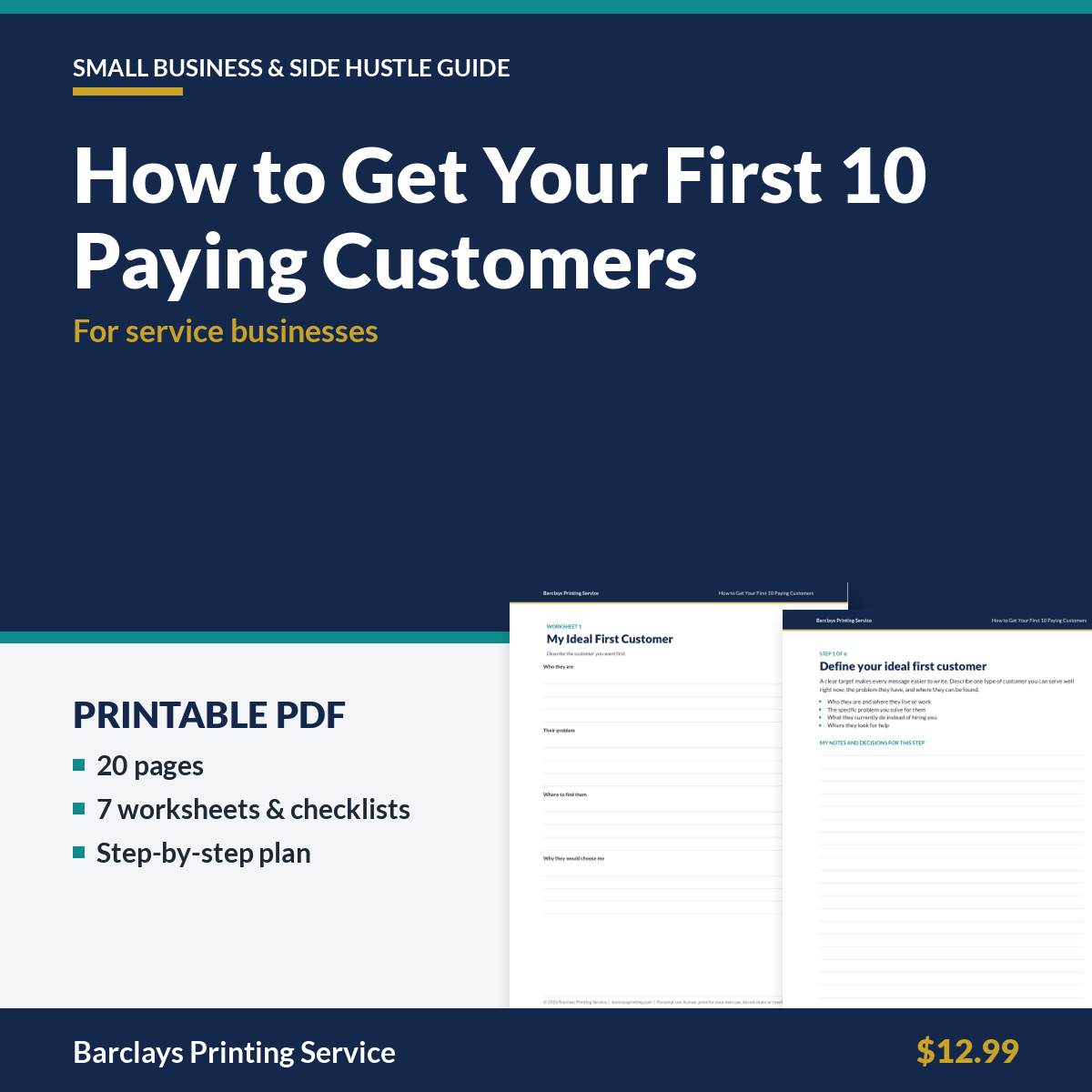
How to Get Your First 10 Paying Customers is a 42-page printable PDF guide for $12.99. The ZIP includes a fillable version and a flattened print version. It includes 6 steps, 12 worksheets and trackers (My ideal first customer; Starter offer and pricing builder; a 4-page 100-contact tracker; My personalized outreach messages; Booking pipeline; My first ten paying customers; 30-day daily action tracker; Weekly sales scorecard; and Quote builder and objection log), plus 20 ready-to-adapt outreach messages, 3 practical business case studies, and a 30-day acquisition challenge. It is an instant digital download; no physical item ships.