
Custom printing from home combines creative work with real production. You are not just designing a shirt or a mug; you are choosing equipment, buying blanks, managing material costs, scheduling production time, sending proofs and keeping customers informed. Without a plan, it is easy to buy the wrong machine, underprice orders or get overwhelmed the first time a busy season hits.
Most custom printing customers buy for events and milestones: birthdays, family reunions, graduations, memorials, church programs, team uniforms and small business branding. That means deadlines, accuracy and clear communication matter as much as print quality. This post lays out a six-step plan for creative entrepreneurs who want to sell t-shirts, mugs, tumblers, stickers, banners or event items from home, whether you are starting from scratch or organizing a small operation that has already begun.
Step 1: Choose a Focused Starting Product Line
The fastest way to drain a startup budget is to try to offer everything. Start with two or three products that share equipment and materials instead. A focused line means less equipment, less inventory and faster skill growth.
- List the products customers in your area ask for
- Group them by the process and equipment needed
- Pick the group with the lowest startup cost
- Plan what you will add later
Grouping by process makes the choice clearer. Heat transfer (vinyl or DTF) covers apparel and bags. Sublimation covers polyester apparel, coated mugs and tumblers. Printable vinyl and cutting covers stickers, decals and labels. Large format covers banners, signs and posters. Heat-transfer apparel paired with sublimation drinkware, or vinyl stickers paired with decals, are examples of lines that share tools.
Step 2: Plan Equipment and Workspace
The sticker price of a machine is only part of what it costs. Compare equipment by total cost of ownership: the machine itself, consumables, maintenance, replacement parts and any software subscriptions.
- Compare at least three options per machine type
- Include consumables and replacement parts
- Check power, ventilation and table space
- Plan storage for blanks and finished orders
Measure your space before you buy, check the power and ventilation needs of each machine, and follow each manufacturer’s safety instructions. If a heat press is on your list, Types of Heat Press Machines explains the main styles.
Buy blanks in small quantities
Stocking every size and color up front ties up money in shirts and mugs that may never sell. Buy blanks in small quantities until you know which sizes and colors your customers actually order, and keep a simple record of suppliers, unit costs, what you have on hand and when to reorder.
Step 3: Set Up the Business Side
A home-based business still has to follow local rules. Before you take orders, look into:
- Home-business and zoning rules (check locally)
- Business registration and sales tax (check with your state)
- Insurance questions for your agent, including coverage for business equipment and products
- A separate bank account or ledger, so business money stays apart from personal money
Set up a receipt and bookkeeping system now, while there are only a few transactions. It is much harder to sort out a year of mixed receipts later.
Step 4: Price Every Order on Real Costs
Each item has a blank cost, a print or transfer cost, labor time and a share of overhead. Add those together and you have your item cost:
- Blank + transfer or ink + labor + overhead = item cost
- Add per-order setup and design time
- Set quantity price breaks
- Charge for rush orders and design work
The per-order setup time is the piece most beginners miss. Preparing artwork, cutting, weeding and test pressing take roughly the same time whether the order is for one shirt or twenty, which is why small orders cost more per piece. Building that into your quote, rather than pricing per item alone, keeps one-off orders from losing money. For a worked approach to apparel specifically, read How to Price Custom T-Shirts for Your New Print Business.
Step 5: Run Orders With Proofs and Deposits
A clear order process prevents most problems. Every order should follow the same path:
- An intake form with products, colors, sizes, quantities, print locations and exact text
- A digital proof with exact spelling
- Written approval before production
- A deposit before you order blanks
- A quality check before handoff
Never start before the proof is approved
A misspelled name on a family reunion shirt is a costly mistake when it is printed on fifty pieces. Get the proof approved in writing, then check every item against the order before handoff: spelling, counts and sizes. Only print designs the customer owns or has permission to use, and decline requests to copy trademarked logos or characters.
Step 6: Market Locally and Build Repeat Business
Event-driven customers come back. A family that orders reunion shirts this summer may need them again next year, and a team will need new uniforms next season. Keep a simple customer list, note their event dates and reach out ahead of the season.
- Show finished work with permission
- Create seasonal offers ahead of graduation, holidays and reunions
- Ask for referrals and reviews
- Keep a calendar of customers’ annual events
Partner with schools, churches, teams, event planners and small businesses. A month-by-month marketing calendar helps you plan outreach before the busy seasons arrive instead of scrambling once they start.
Common Mistakes to Avoid
- Buying several machines before selling anything
- Pricing per item without adding order setup time
- Starting production before a written proof approval
- Printing logos or characters without permission
- Stocking every size and color of blanks up front
Please note: this is general business-planning information, not legal, tax or financial advice. Weigh equipment options for your own needs and budget before you buy. Home-business, zoning, licensing and sales-tax rules differ by location, so confirm local requirements with your city or county and a qualified professional before you start.
Get the Full Home-Based Printing Business Guide
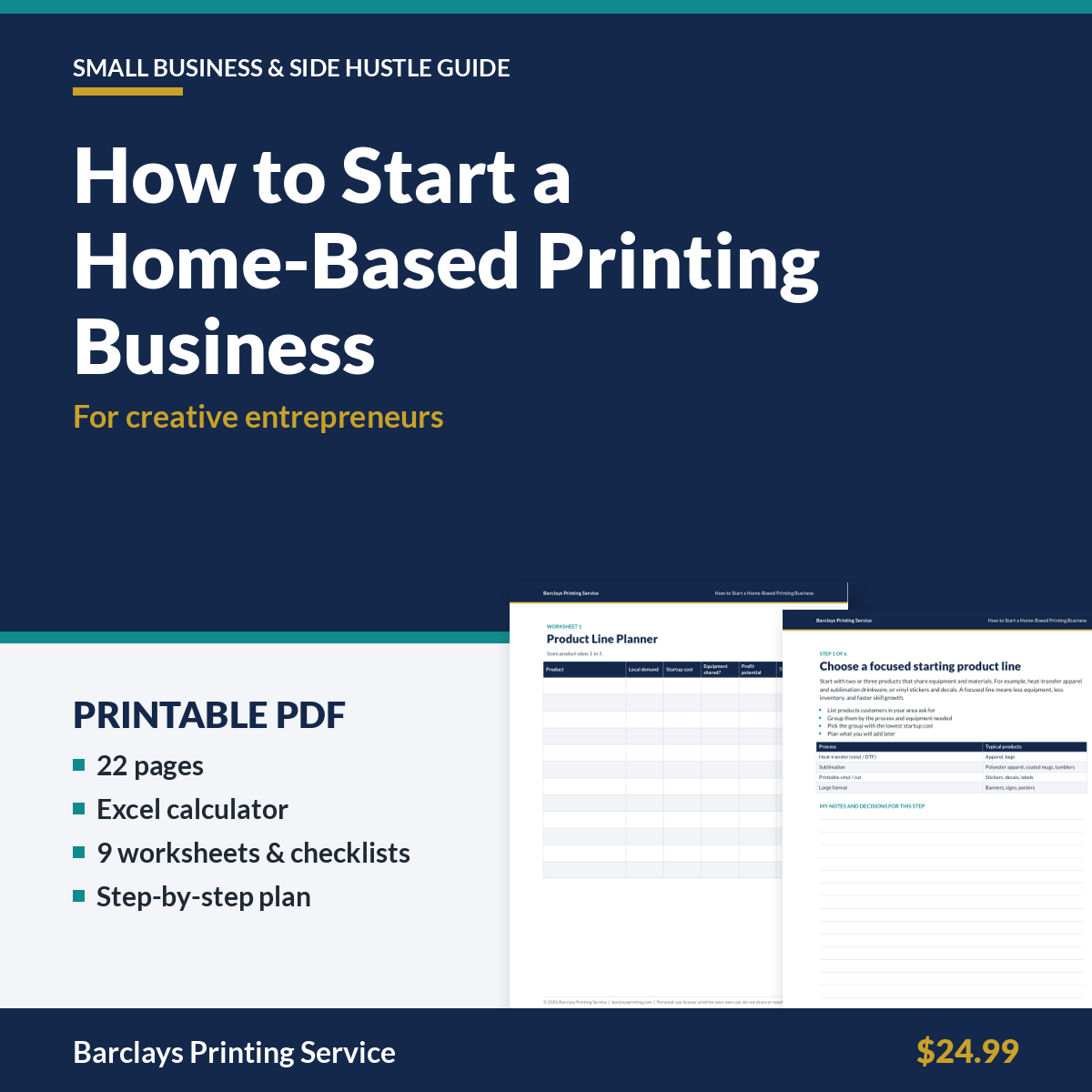
How to Start a Home-Based Printing Business is a 22-page printable PDF guide for $24.99, with a companion Excel calculator for item costs and order quotes. It includes 9 worksheets and checklists: Product Line Planner, Equipment Comparison, Business Setup Checklist, Per-Item Cost Sheet, Order Intake Form, Production and Quality Checklist, Seasonal Marketing Calendar, Supplier and Blank Inventory, and Customer Quote Template, plus a personal action plan. It is an instant digital download; no physical item ships.