
A monthly rate for a furnished room has two sides. The first is the floor: the lowest amount that covers the real costs of offering the room. The second is the market: what similar rooms nearby actually charge. A useful price sits at or above your floor and still makes sense against those comparables. Guessing from a single listing, or copying last year’s number, can leave the room empty or leave you covering costs out of pocket.
This post walks room landlords through a six-step way to price a furnished room for monthly or mid-term rentals, from building a cost floor to reviewing the rate before each new tenant.
Important: this is general information, not legal, tax or real-estate advice. Landlord, zoning, licensing, insurance and tax rules differ by location. Check with your local authority and qualified professionals before acting, and check local landlord-tenant law for deposits, notice and rent rules before you finalize terms.
Step 1: Calculate Your Monthly Cost Floor
Start with every cost the room adds, not only the obvious ones. A share of utilities and internet, cleaning between tenants, supplies, furniture and linen replacement, insurance, repairs, listing or platform fees and any taxes all belong in the picture. If a cost is annual, divide it by 12 so you can work in monthly figures.
- Utilities share (electric, water, gas, internet)
- Furniture and linen replacement allowance
- Cleaning between tenants
- Insurance and maintenance share
- Listing or platform fees
Furniture and linens wear out with regular use. If you skip a replacement allowance, your floor looks lower than it really is, and you feel that gap when a mattress or a set of towels needs replacing. The point of this step is a complete monthly cost, not a perfect forecast of every future repair.
Step 2: Allow for Vacancy
Rooms are not rented every day of the year. Time between tenants, a slow season or a cancellation can leave the room empty, and the months it is rented need to cover the months it is not. Estimate how many weeks per year the room may sit empty, then convert that into an occupancy figure and a required rate:
- Estimate weeks empty per year
- Occupancy = (52 – empty weeks) / 52
- Required rate = monthly cost / occupancy
If you are new to renting the room, treat the vacancy estimate as a working number and revise it after you have a few stays behind you. Trying two or three vacancy estimates is useful, because a small change in empty weeks can move the minimum rate more than you expect. Your advertised price should not go below this required rate if you want costs covered over the year.
Step 3: Research Comparable Rooms
Find at least five comparable listings nearby and write down more than the asking price. Record size, furniture, whether the bathroom is private or shared, whether utilities are included, parking, minimum stay and, if you can see it, how long the listing has been up. A high price that has sat unfilled for weeks is not the same as a price that rooms actually rent at.
- Same area or similar transit access
- Similar size and furnishings
- Bathroom: private or shared
- Utilities included or extra
- Minimum stay length
Features that often change the comparison
- Private bathroom: usually supports a higher rate than a shared bath
- Utilities included: usually supports a higher rate than utilities billed separately
- Parking: can support a higher rate where parking is scarce
- Shared kitchen only: may sit lower than a room with a kitchenette
Stay in the same market you are actually competing in. A larger apartment across town, or a short-term listing priced by the night, is not a true comparable for a monthly furnished room.
Step 4: Adjust for What Your Room Offers
Score your room against those comparables. A private bath, parking, laundry, a workspace or flexible terms can justify a rate toward the higher end of the range. A smaller room, a shared bath or a longer commute may need a lower one. List the advantages honestly, and list the disadvantages the same way.
Then place your rate inside the comparable range, at or above your cost floor. If the market range sits below your floor, you have a decision to make: lower costs, add value guests will pay for, or accept that the room may take longer to rent at a rate that covers you. Do not solve that gap by ignoring the floor.
Step 5: Decide Terms, Deposits and Utilities
Price and terms work together. A slightly lower all-inclusive rate can be easier to compare, while a lower base rent plus utilities may look cheaper at first and then surprise a tenant. Decide these points in writing before you list the room:
- Minimum stay and notice period
- All-inclusive rent or utilities billed separately
- Deposit amount (check local limits)
- Payment date and method
Deposit limits, notice periods and tenant protections vary by location, so check local law before you set a number or a policy. If you include utilities, go back to the estimate you made in Step 1 so the “included” part is based on a real figure, not a guess.
Step 6: Review Your Rate Regularly
Review the rate before each new tenant and at least once a year. Update your costs, look at five comparables again and note how many inquiries you received and how quickly the room rented. A room that rents immediately every time may be priced below the market. A room that sits empty may be priced above it, or the listing may be missing information tenants need.
Write down any change and the reason for it. That history makes the next review faster, because you can see what you tried and what happened afterward, instead of starting from a blank page.
Common Mistakes to Avoid
- Copying one listing’s price
- Ignoring vacancy between tenants
- Forgetting furniture and linen wear
- Including utilities without estimating them
- Setting deposits without checking local law
If the room itself is not yet set up for a paying occupant, start with our post on how to prepare a spare room for paying guests. If your likely tenants are traveling workers, our How to Rent to Traveling Professionals guide covers that audience in more detail.
Get the Printable Room Pricing Guide
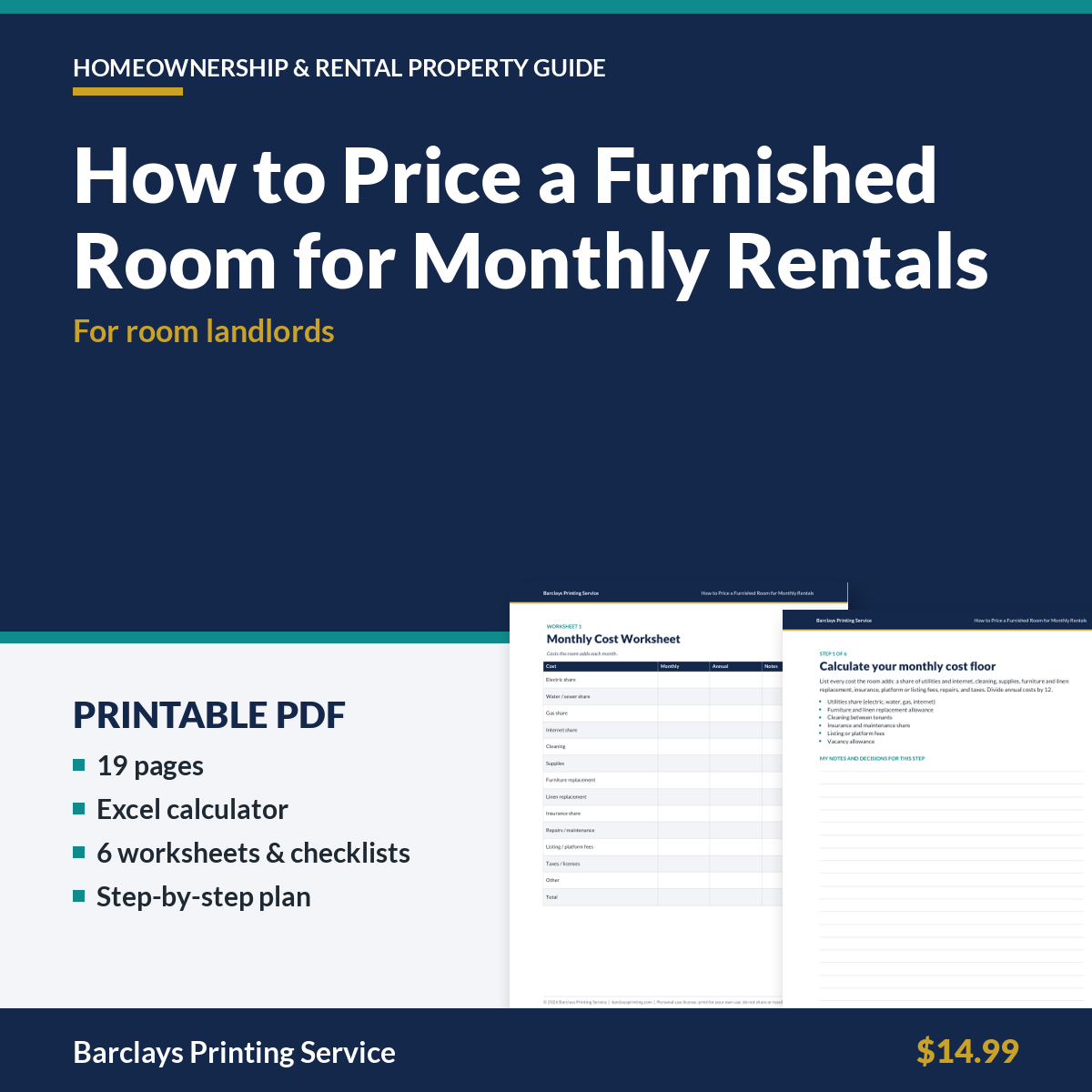
Our How to Price a Furnished Room for Monthly Rentals guide is a 19-page printable PDF for room landlords, priced at $14.99. It includes a Monthly Cost Worksheet, a Vacancy and Floor Price worksheet, a Comparable Rooms Research sheet, a Feature Comparison Score, a Rental Terms Sheet and a Rate History Log, plus a personal action plan and an Excel calculator. It’s an instant digital download you can print and fill in as you set and review your rate.