
If you manage health appointments for other people, you know how quickly the details pile up. There’s the specialist your mom sees twice a year, your child’s pediatrician, a partner’s new prescription, a referral that needs to reach the right office, a test result you’re still waiting on. When you’re juggling several providers, changing medications and instructions, often for more than one person, it’s easy to forget a question, lose a referral or miss a follow-up.
Appointments go better when you arrive prepared: the right records, an up-to-date medication list and your questions written down. Afterwards, writing down instructions while they’re fresh prevents confusion. This post walks family caregivers, parents and adults managing appointments for children, partners, aging parents or themselves through a simple six-step system.
Please note: this post and the organizer it’s based on help you keep records. They are not medical advice. Always follow the guidance of qualified health professionals, ask them about anything that’s unclear, and call your local emergency number in an emergency.
Step 1: Build a Health Profile for Each Person
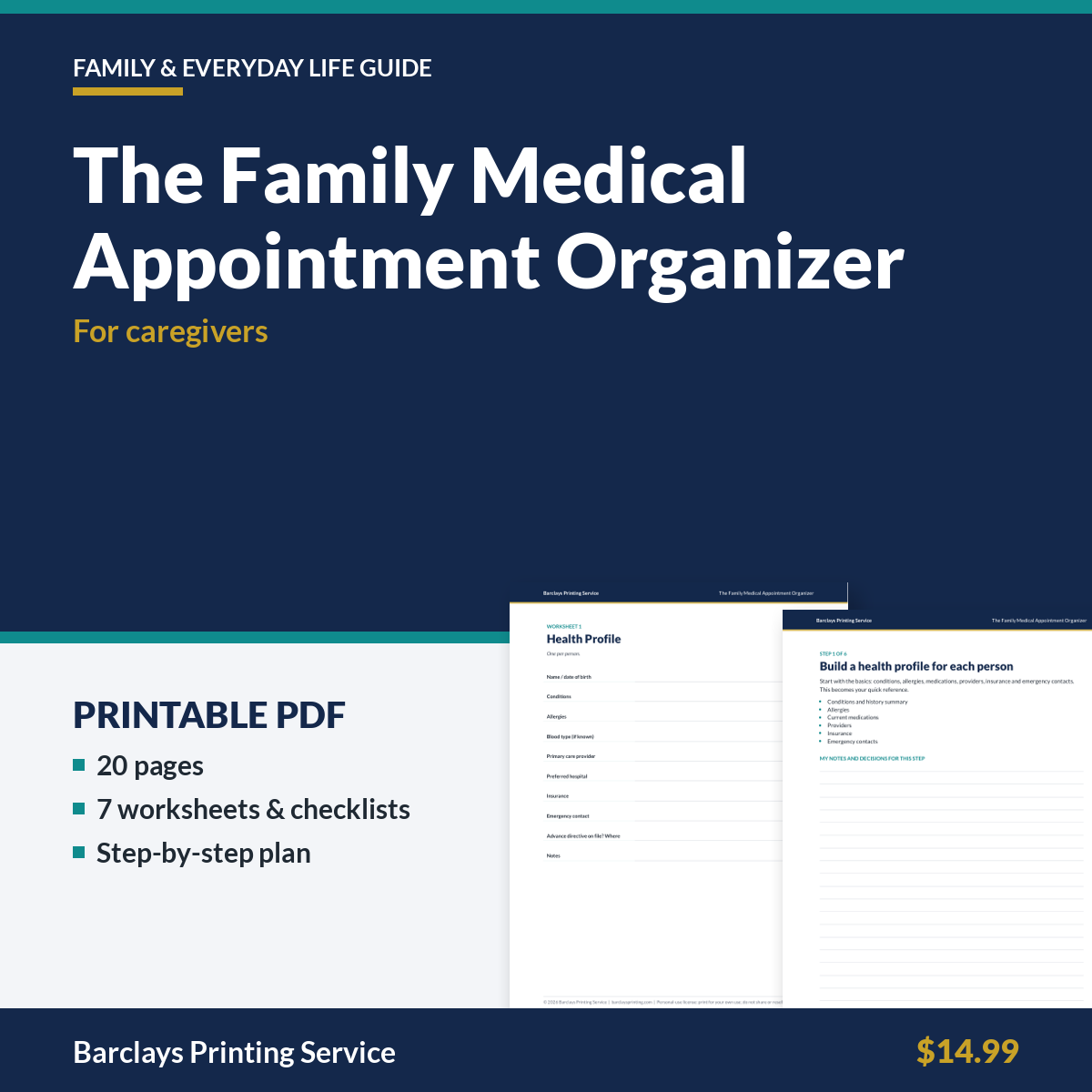
Start with a one-page quick reference for every person you care for. When a new provider asks for history, or you’re filling out yet another intake form, you’ll have the answers in one place. Each profile should cover:
- Name and date of birth
- A summary of conditions and history
- Allergies
- Current medications
- Blood type, if known
- Primary care provider and preferred hospital
- Insurance
- Emergency contacts
- Whether an advance directive is on file, and where
Keep one profile per person. Mixing two people’s details on the same page is a quick route to mistakes.
Step 2: Keep a Provider Directory
List every provider involved in each person’s care, with their specialty, phone number, patient portal and location type. Don’t forget the less obvious ones:
- Primary care
- Specialists
- Pharmacy
- Labs and imaging
- Therapists
Two details make the directory far more useful: who referred whom, and when the next visit is due. When a specialist’s office asks for a referral, you’ll know exactly where it came from. And when you glance at the “next visit due” column, you’ll catch the checkup that would otherwise slip by.
Step 3: Prepare for Each Appointment
Arriving without written questions is the first mistake on the list. Ten minutes of preparation before each visit makes a real difference. Before you go, write down:
- Your top 3 questions, first. Appointments can be short, so put the most important ones at the top.
- Symptoms and changes since the last visit.
- Medication questions.
- What you need from this visit, whether that’s a refill, a referral or a clear next step.
Then gather what to bring: the current medication list, the insurance card and ID, and a referral if one is required. It’s also worth asking ahead of time whether you can bring a support person.
One tip from the organizer: ask the provider to repeat or write down instructions. It’s fine to say, “Can you explain that another way?”
Step 4: Record Visit Notes and Instructions
During or right after the visit, write down what was discussed. Memory fades fast, especially after a stressful appointment. Capture:
- Diagnoses or findings discussed
- Medication or care plan changes
- Tests and referrals: what, where, and when results are expected
- The follow-up date, and who schedules it
- Who to call with questions
That last line matters more than it seems. When a question comes up three days later, knowing whether to call the specialist’s nurse line or the primary care office saves time and frustration. Then add any follow-up to your appointment calendar right away, along with who is going, which provider, the purpose, transport and whether it’s confirmed. Missing follow-up dates is another of the common mistakes this system helps you avoid.
Step 5: Manage Medications Carefully
An out-of-date medication list causes confusion at nearly every appointment. Keep one medication list per person, recorded exactly as given by the prescriber:
- Medication name, dose and schedule (as prescribed)
- Purpose and prescriber
- Start and stop dates
- Refill dates
- Pharmacy
Update the list whenever something changes, and share it at every appointment and with the pharmacy. The list is a record of what providers have prescribed, not a place to make changes yourself. If something looks wrong or unclear, ask the prescriber or pharmacist.
Step 6: Track Results, Insurance and Costs
The paperwork after appointments can be as demanding as the appointments themselves. Keep a simple log of:
- Results, recorded as they’re shared with you.
- Insurance calls, with the date, who you spoke with, the reference number, the topic, the outcome and any follow-up.
- Bills and payments, including out-of-pocket costs.
- Appeals or questions you’re still waiting on.
Losing insurance reference numbers is a very common frustration. When you have to call back about a claim, being able to say “I spoke with someone on this date, and the reference number was…” can make the call much shorter.
Insurance cards, policies and other health paperwork are easier to find when the rest of your household’s papers are organized, too. Our post on how to organize important family documents walks through a simple filing system.
Common Mistakes to Avoid
- Arriving without written questions.
- An out-of-date medication list.
- Not writing instructions down.
- Losing insurance reference numbers.
- Missing follow-up dates.
Keep It All in One Binder
The system works best when everything lives in one place: a folder or binder with a section for each person. Put the health profile at the front, followed by the provider directory, medication list, upcoming appointments, then visit notes and the insurance log. Grab it on your way out the door to every appointment. If you also care for a parent who lives in another city, the Long-Distance Family Care Coordination Kit helps you organize the wider care team.
Get the Printable Family Medical Appointment Organizer
Our Family Medical Appointment Organizer is a 20-page printable PDF for caregivers, priced at $14.99. It includes a Health Profile, Provider Directory, Appointment Calendar, Appointment Prep Sheet, Visit Notes, Medication List and Insurance and Billing Log, plus a personal action plan. It’s an instant digital download you can print as many times as you need. It helps you keep records and is not medical advice, and no specific outcome is promised.