
Most of us check our bank balance every week, but rarely step back to look at the whole picture. Did your spending creep up this year? Is your emergency fund where you wanted it? When did you last check who’s listed as a beneficiary on your accounts? These questions are easy to put off until something forces them.
An annual review takes a few hours and gives you a clear snapshot: where you are, what changed, and what to focus on next year. This post walks through the six steps in our printable Annual Personal Finance Review Kit, so you can do your own money check-up in one sitting or across a quiet weekend.
Please note: this post and the kit are general information for organizing your own money. They are not financial, tax or legal advice. For decisions about your situation, consult a qualified professional.
Step 1: Gather Your Statements
The review goes faster when everything is in front of you before you start. Collect year-end or recent statements for:
- Bank accounts and credit cards
- Loans
- Retirement and investment accounts
- Insurance policies (the declarations pages)
- Pay stubs and other income records
It also helps to have your beneficiary information, your credit reports, your tax return and last year’s review, if you did one. If your accounts are scattered across several logins and paper files, our post on how to organize your financial accounts can help you pull them together first.
Step 2: Review Income and Spending
Compare your total income and total spending with last year. Then look at spending by category and note which ones grew. The question isn’t whether a category went up, it’s whether that was intentional. Write down:
- Total income
- Total spending by category
- The change from last year
- Any surprises
A category that grew because you chose to spend more on something you value is fine. A category that grew without you noticing is the one to look at for next year.
Step 3: Calculate Your Net Worth
Net worth is simply what you own minus what you owe:
| Category | Examples |
|---|---|
| Assets | Cash, retirement, investments, home value estimate, vehicle |
| Liabilities | Mortgage, car loan, cards, student loans |
| Net worth | Assets – liabilities |
Track the direction, not the number
The kit is clear on this: track net worth each year to see its direction, not to judge yourself. A negative number is common, for example for people paying off student loans. What matters is whether it’s moving the way you want from one year to the next.
Step 4: Review Savings and Debt
Next, check how your savings and debt are doing:
- How many months of expenses your emergency fund covers
- Progress toward each savings goal
- Each debt’s balance and interest rate
- Payoff progress since last year
Note what improved and what the next step is for each item. If your emergency fund needs work, see our post on how to build a three-month emergency fund. If debt is the focus, our Debt Payoff Planning Workbook post walks through building a payoff plan.
Step 5: Check Protection and Paperwork
This is the part people skip most often, and it’s the one that can matter most if something goes wrong. Review:
- Health, life, disability, home or renters, and auto coverage
- Beneficiaries on your accounts and policies
- Your retirement contribution rate
- Your will and other documents
- Your credit reports
You don’t need to have the answers to everything here. Write down your questions for an insurance agent, financial professional or attorney, and book the conversations. For credit reports, the kit recommends using the official free sources available in your country.
Beneficiaries are easy to forget
Outdated beneficiaries are one of the common mistakes the kit calls out. Life changes like marriage, divorce or a new child are good reasons to check them, even outside your annual review.
Step 6: Set Goals and a Plan for Next Year
Finish the review by choosing three to five money goals for the year ahead. For each one:
- Give it a number and a date
- Break it into monthly actions
- Pick a mid-year check-in date
“Save more” is a wish. “Add a set amount to savings each month until a set date” is a goal you can track. The mid-year check-in keeps the plan from fading by spring.
Common Mistakes to Avoid
- Skipping the review in a busy year
- Judging your net worth instead of tracking its direction
- Leaving beneficiaries out of date
- Setting goals without numbers or dates
- Skipping the mid-year check-in
How to Make the Review a Habit
The hardest part of an annual review is starting it, especially in a busy year, which is exactly when it’s most useful. A few ways to make it stick:
- Put it on the calendar. Pick the same time each year, such as the first quiet weekend after year-end statements arrive, and block a few hours.
- Work one step at a time. Read each step once, then fill in the matching worksheet while the ideas are fresh. You don’t have to finish everything in one sitting.
- Keep last year’s pages. Your previous review is one of the documents to gather, so file this year’s worksheets where you’ll find them next time. Comparing years is where the real insight comes from.
- Use pencil for anything you expect to update, like balances you’re still confirming or questions waiting on a professional’s answer.
Finish with the Year in Review Reflection: a few honest notes about what went well and what you’d change make next year’s goals much easier to set.
Get the Annual Personal Finance Review Kit
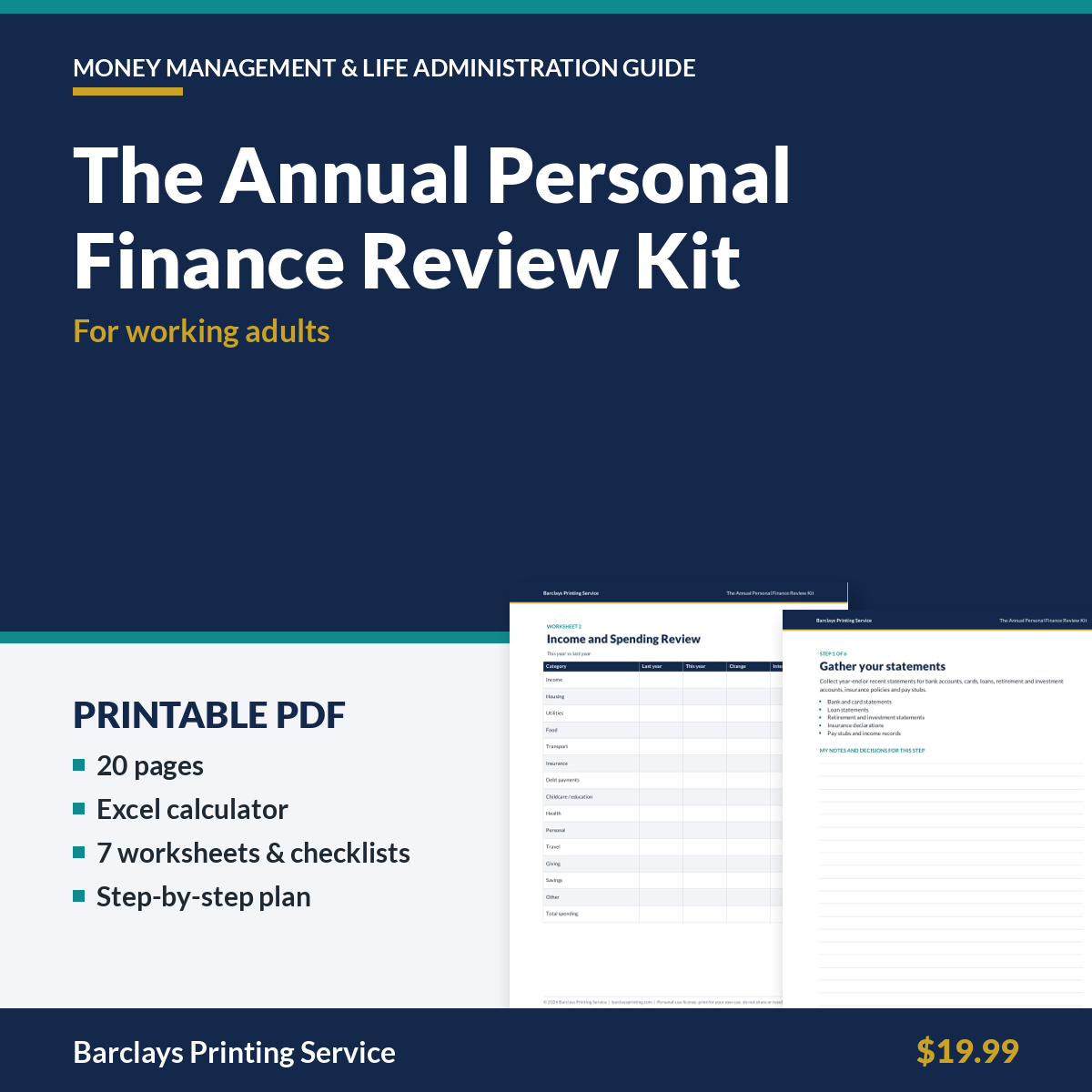
The Annual Personal Finance Review Kit is a 20-page printable PDF that walks you through all six steps, with seven worksheets and checklists: Documents to Gather, Income and Spending Review, Net Worth Statement, Savings and Debt Check, Protection and Paperwork Review, Next Year’s Money Goals, and a Year in Review Reflection. It also includes an Excel calculator with working formulas, plus an action plan and notes pages. It’s an instant download for $19.99. Get the kit here.