
Ask a group of handmade sellers how they set their prices and you will hear a lot of “I looked at what everyone else charges” and “it felt about right.” The trouble is that a price based on a feeling often leaves out the costs that quietly eat your profit: packaging, platform fees, and most of all, your own time.
A good price is the result of a few honest numbers. This post walks through those numbers in six steps, written for Etsy sellers and other makers who want prices that cover materials, time, fees and still leave a profit.
Please note: this is general business information, not financial, tax or legal advice. Marketplace fees, sales tax and business rules differ by platform and location. Check current fees with your selling platform, and confirm tax and licensing questions with your local authority or a qualified professional.
Step 1: Count Every Material, Down to the Small Stuff
Materials are more than the main supply. Thread, glue, tags, labels, tissue paper, stickers, branded inserts and the shipping box all belong in the cost of an item. If you leave them out, you are paying for them out of your profit on every sale.
The key habit is to price each material per unit used, not per package. If a 100-pack of gift boxes costs a set amount, the cost per item is that amount divided by 100. If a spool of ribbon covers about 50 items, divide its price by 50. Write the math down once and reuse it.
- List every material for one product, including packaging
- Convert bulk purchases into a cost per item
- Add a small allowance for waste and test pieces
- Recheck supply prices every few months
Step 2: Pay Yourself for Your Time
Time is the cost makers most often leave out, and it is usually the biggest one. Time yourself making a single item, then time a batch of five and work out the average per item. Batching is often faster, and you want to know by how much.
Do not stop at the making itself. Include prep, finishing, photography, writing the listing, packing and the trip to drop off the order. Then choose an hourly rate you would honestly accept for this work, and use this formula:
Labor cost = minutes per item ÷ 60 × your hourly rate
If that number looks uncomfortable, that is useful information. It means either your process can be streamlined or your current price is subsidized by unpaid hours.
Step 3: Account for Fees and Overhead
Platform and payment fees
Selling platforms and payment processors charge fees, often a mix of fixed amounts and percentages: listing fees, transaction fees, payment processing, shipping label fees, advertising fees and sometimes currency conversion. These change, so look up the current numbers on your platform’s official fee page and write them down with the date you checked. Review them whenever the platform announces changes.
Overhead
Overhead is everything not tied to one specific item: a share of your tools and equipment, software and apps, a share of internet and phone, studio space, subscriptions and advertising spend. Add up a typical month, then divide by the number of items you sell in a month. That gives you an overhead share to add to every product.
Step 4: Build Your Price With a Formula
Once you have the pieces, the price comes from simple math:
- Total cost = materials + labor + overhead share
- Target before fees = total cost + the profit you want to keep
- Price = (target + fixed fees) ÷ (1 − percentage fees)
- Round to a clean price point
That third line is the one most sellers miss. Percentage fees are taken from the selling price, not from your cost. If you simply add fees on top of your cost, the percentage portion still comes out of your profit. Dividing by (1 − the percentage) works backwards from your target, so that after the platform takes its share, you still keep the profit you planned.
For a related walk-through aimed at print sellers, see our post on how to price custom t-shirts.
Step 5: Check the Market Without Racing to the Bottom
Your calculated price is your floor, not a guess. Now compare it with the market, but compare like with like: similar materials, size, finish and shop reputation.
- Find five comparable listings and record their prices
- Note what makes yours different
- Decide whether you are positioned as budget, mid-range or premium
- Never price below your total cost
If your price sits higher than similar items, show why in your photos and description. If your calculated price is far above the market, look at your process before you cut your pay. Batching, cheaper sourcing or a simpler design can lower your cost without lowering what you earn per hour.
Step 6: Review and Raise Prices With Confidence
Prices are not set-and-forget. Supply costs and platform fees move, and a price that was profitable last year may not be now. Put a review date on your calendar every quarter and recalculate each product with current numbers.
- Recalculate each product quarterly
- When you raise prices, update your listings together and keep a record
- Track sales before and after a change
- Retire products that cannot be priced profitably
- Offer bundles to increase order value
Keeping a simple log of old price, new cost, new price and the date changed turns price increases from a nervous guess into a routine decision.
Common Pricing Mistakes to Avoid
- Leaving labor out of the price
- Forgetting packaging and small materials
- Subtracting fees from profit instead of pricing them in
- Copying competitors’ prices without knowing your costs
- Never reviewing prices after supply costs change
Want to see whether the whole shop is profitable, not just each item? Our guide How to Calculate Your Real Business Profit takes the same approach to your full monthly numbers.
Get the Handmade Pricing Guide and Calculator
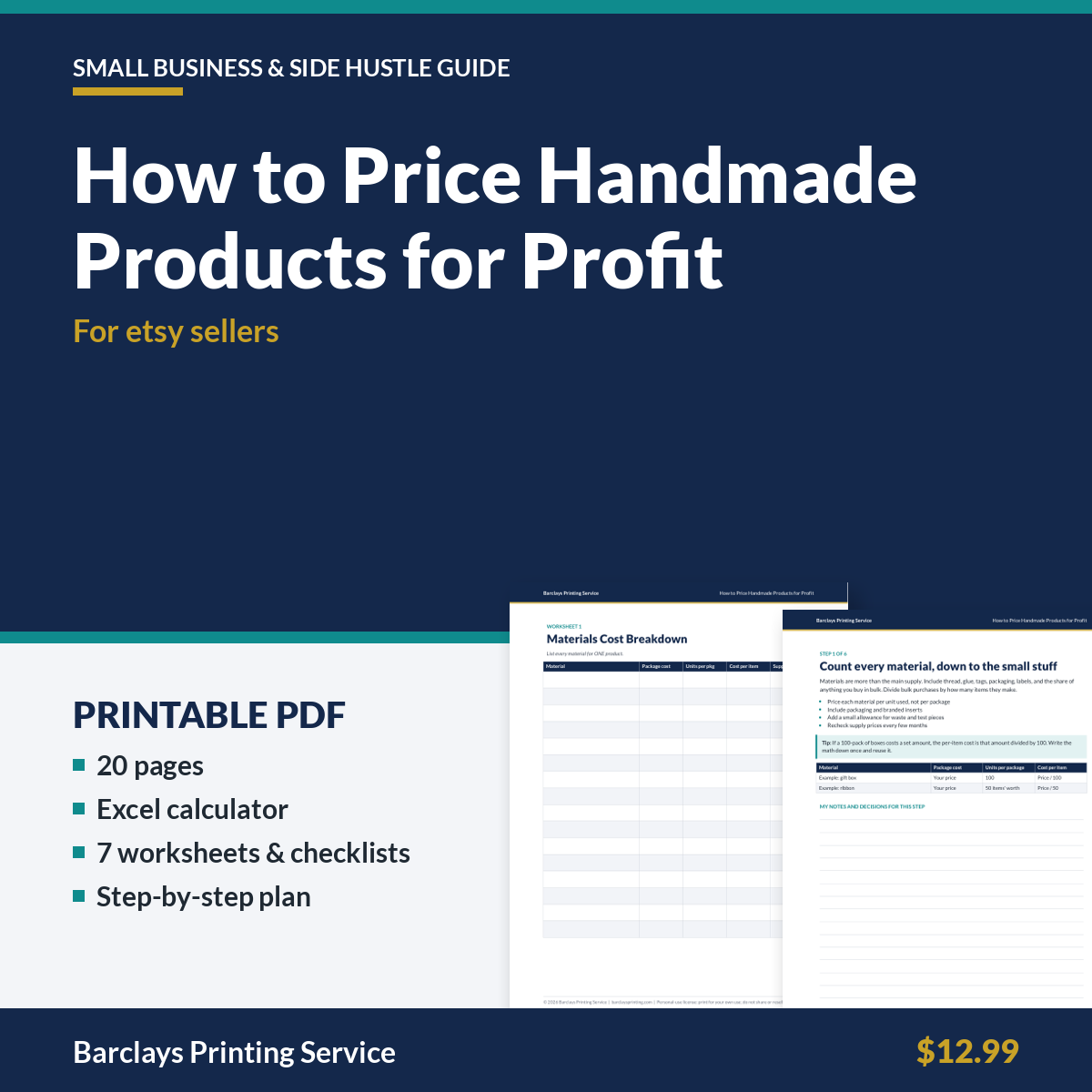
How to Price Handmade Products for Profit is a 20-page printable PDF guide for $12.99, with an Excel calculator that has the pricing formula built in. It includes 7 worksheets: Materials Cost Breakdown, Time Study, My Platform Fees Record, Monthly Overhead Worksheet, Price Build Sheet, Competitor Comparison and Quarterly Price Review, plus a personal action plan. It is an instant digital download; no physical item ships.