
Plenty of small-business owners can tell you how much they sold last month. Far fewer can tell you how much the business actually kept. Money comes in through a card reader, a marketplace, a few paid invoices and the odd cash sale, and money goes out through supplies, subscriptions, fees and a dozen small charges that are easy to forget. The bank balance goes up and down, and it is tempting to treat that balance as profit. It isn’t.
This post walks small-business owners through a simple, repeatable way to calculate business profit: the three numbers that matter, how to gather complete income and expense records, why your own time belongs in the math, and how to find out which products or services really earn their keep. You don’t need accounting software to start. A pencil, three months of statements and a few honest hours will do.
Please note: this is general business information, not accounting, tax or financial advice. It helps you organize your own business numbers. For tax filings and major business decisions, consult a qualified accountant or tax professional.
Step 1: Learn the Three Profit Numbers
Profit is what remains after every cost of running the business. Three numbers describe it, and each answers a different question.
- Revenue is all money from sales. It answers: how much did we sell?
- Gross profit is revenue minus the direct costs of what you sold. It answers: are our prices high enough over direct costs?
- Net profit is gross profit minus all other business expenses. It answers: does the whole business make money?
Add a fourth question that many owners skip: am I paid for my time? We will come back to that in Step 4.
Two short formulas are worth memorizing. Gross margin is gross profit divided by revenue, which shows what share of each sale is left after direct costs. Net profit is gross profit minus operating expenses. If gross margin is thin, the problem is usually pricing or materials. If gross margin looks healthy but net profit is weak, the problem is usually overhead.
Step 2: Gather Complete Income Records
Your profit number is only as good as the records behind it. Collect income from every channel you use: cash, card processors, online platforms and paid invoices.
- List every way you receive money
- Download monthly statements or reports from each one
- Separate refunds and returns
- Note unpaid invoices separately, since they aren’t money in hand yet
One habit makes a big difference: record each sale at the amount before fees, and record the fees separately as an expense. Many platforms pay out a net figure with fees already taken off. If you record only the payout, the fees disappear from view, and you can’t tell how much your payment processors and marketplaces are actually costing you.
Step 3: Sort Every Expense
Next, go through at least three months of bank and card statements line by line. Most missed expenses are small subscriptions that renew quietly in the background. As you go, sort each cost into a group:
- Direct costs tied to sales: materials, supplies, packaging and contractor work for a specific job
- Fixed operating costs: rent, insurance, software and phone
- Variable operating costs: marketing, shipping supplies you don’t charge for, travel
- Annual or irregular costs divided by 12, such as a yearly domain renewal, license or equipment service
- Payment and platform fees
The annual costs deserve extra attention. A bill that arrives once a year can make one month look terrible and the other eleven look better than they are. Spreading it evenly gives you a truer monthly picture. While you are in the statements, mark each expense as keep or cut. You will likely find at least one tool you stopped using.
For print and product businesses
If you sell physical items, be careful about what counts as a direct cost. Blank shirts, transfer film, ink, vinyl, labels and packaging for a specific order are direct costs. A heat press or printer you use for every job is equipment, which belongs elsewhere in your records. For a step-by-step way to build those direct costs into your prices, see our post on how to price handmade products for profit.
Step 4: Value Your Own Time
If you don’t pay yourself, the business may look more profitable than it is. A shop that shows a modest net profit while the owner works long weeks unpaid is really paying the owner very little per hour.
- Track your hours for two to four weeks, including admin, messages and errands, not just production
- Choose a fair hourly value for the work you do
- Compare net profit with the hours you worked
- Calculate profit per hour
Then work out profit after owner pay: net profit minus your hours multiplied by your hourly value. This number shows whether the business could pay someone to do your job. It is often uncomfortable to see, but it is the number that tells you whether to raise prices, cut work that doesn’t pay, or change how you operate.
Step 5: Find Your Most and Least Profitable Offers
Business-wide profit tells you whether the whole thing works. Product-level profit tells you where it works. For each product or service, write down:
- Price per unit
- Direct cost per unit
- Gross profit per unit and margin percentage
- Units sold per month
Some popular items may earn very little, while a quieter item may carry the business. Once you can see the numbers side by side, decisions get easier: promote the items with strong margins, reprice the ones that barely cover their costs, and consider dropping items that take a lot of time for little return.
Step 6: Review Monthly and Act
A profit calculation done once is a snapshot. Done every month, it becomes a habit that steers the business.
- Pick the same day each month to update your numbers
- Compare the month with the previous three months
- Decide one clear action: raise a price, cut an expense or promote a profitable item
One action per review is enough. Small, steady changes are easier to keep up than a big overhaul, and you can see in the following months whether each change helped. A simple monthly statement works well here: revenue, direct costs, gross profit, gross margin, operating expenses, net profit, owner hours, owner pay value, profit after owner pay and profit per owner hour, with one action for next month written at the bottom.
Common Mistakes to Avoid
- Treating the bank balance as profit
- Forgetting annual and irregular costs
- Recording sales after fees instead of before
- Leaving out the owner’s time
- Never calculating profit per product
Get the Printable Profit Workbook
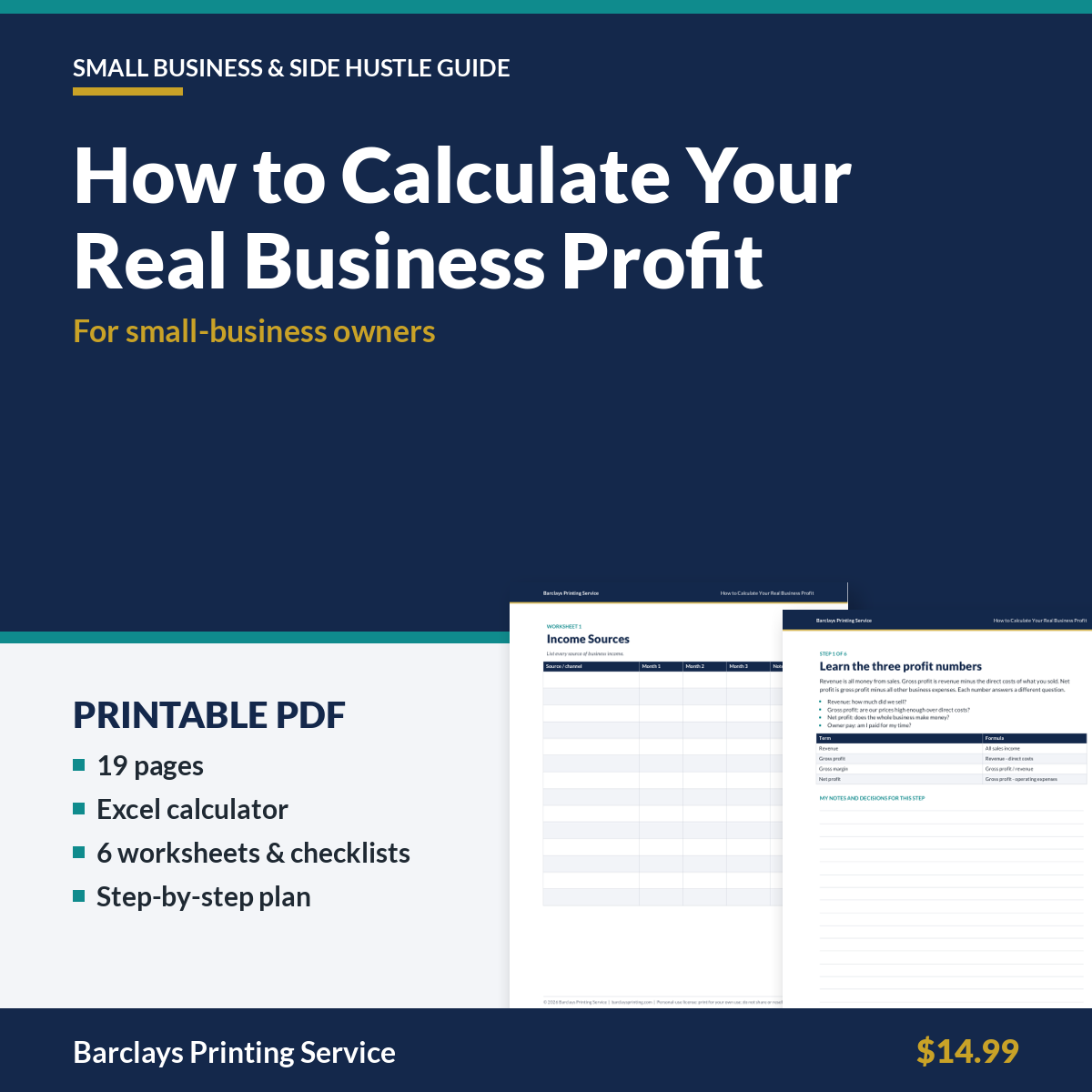
If you want this whole process laid out for you, our How to Calculate Your Real Business Profit guide is a 19-page printable PDF for small-business owners, priced at $14.99. It includes six worksheets (Income Sources, Expense Audit, Owner Time Log, Product / Service Profit Sheet, Monthly Profit Statement and a 12-Month Profit Trend), a personal action plan and an Excel calculator with working formulas. It’s an instant digital download, so you can print the worksheets as often as you need. Just starting out? Pair it with our post on starting a business with $500 or less.