
If you’ve spent years doing your work, whether you’re a coach, a tradesperson, an educator or a consultant, you probably know enough to write a genuinely useful book. Most experts never finish one. The blank page is intimidating, the structure gets tangled and editing drags on for months.
AI can speed up the drafting, but there’s a trap. A book built mainly from AI output tends to sound generic and may contain errors, which is the opposite of what readers want from an expert. The better approach is capture-first: your knowledge is the book, and AI is the assistant that helps you organize, shape and tighten it. This post walks experts through six steps to turn what you know into a practical, AI-assisted ebook that still sounds like you.
Step 1: Define the Reader and the Promise
Pick one reader and one transformation. A focused promise makes every later decision easier, from which chapters to include to what to leave out. Answer four questions:
- Who is the specific reader? Not “anyone interested in my field,” but one clear type of person.
- What problem do they have?
- What will they be able to do after reading?
- Why are you qualified? Base this on your real experience.
Put your answers on a single page along with a working title, a length goal, the formats you plan to publish in and a target publish date. That page is your book blueprint, and you’ll come back to it every time you’re unsure whether something belongs in the book.
Step 2: Capture Your Knowledge First
This is the step that separates an expert’s book from a generic one. Before you ask AI to write anything, gather your raw material:
- Voice recordings or transcripts of you explaining your process
- Answers to the questions clients ask you most often
- Stories and real examples, used with permission or anonymized
- Checklists and frameworks you already use
- Existing notes, presentations and emails
Talking is often faster than typing. Record yourself answering common client questions out loud, transcribe the recordings and use them as the base for your drafts. Keep a simple log of each source, what type it is, its key points and which chapter it belongs to.
Step 3: Build the Outline
With your notes collected, ask AI to suggest a few chapter structures based on them. Then choose the one that fits best and adjust it. You’re the one who knows what order your reader needs.
For a practical ebook, aim for 8 to 12 chapters, each with one clear purpose and a practical takeaway, such as an exercise or checklist. A structure that works for many practical books moves from basics to advanced:
- Foundations: the problem and the key ideas.
- Method: your step-by-step chapters.
- Application: examples, mistakes and tools.
- Next steps: an action plan and resources.
If a chapter doesn’t have a takeaway, it’s either not finished or doesn’t belong.
Step 4: Draft Chapter by Chapter
Give AI one chapter’s notes and outline at a time and ask for a draft in your voice. Working chapter by chapter keeps the AI grounded in your material instead of filling space with general filler. A prompt you can adapt:
“Using my notes below, draft chapter [X] in a warm, direct voice. Keep my examples. Don’t add statistics or facts I didn’t provide; mark gaps as [CHECK].”
Then Rewrite It
The AI draft is a starting point. Rewrite it yourself: add your stories, correct errors and cut filler. Fact-check every claim, especially anything marked [CHECK].
Keep a Voice Guide
To keep drafts sounding like you, write a short voice guide: how you sound (the words and phrases you actually use), what you never say, and the drafting and editing prompts that work. Paste it in with each chapter. Track each chapter’s progress from notes ready, to AI draft, to your rewrite, to fact-checked, to edited, so you always know where the book stands.
Step 5: Edit, Design and Format
Edit in passes rather than trying to fix everything at once:
- Structural edit: does the order make sense, and does every chapter earn its place?
- Clarity edit: is each explanation easy to follow?
- Proofread: catch typos and small errors last.
Ask beta readers, ideally people like your target reader, for honest feedback and address it before publishing. Then design a professional cover and interior and export your book for ebook readers and as a PDF. Before you move on, confirm every fact is checked and every story is anonymized or used with permission.
Step 6: Publish and Launch
Decide where to sell: your own website, a digital product platform or ebook retailers. Each has its own terms, royalties and rules about AI-generated content, and they change, so review each platform’s current terms before you publish and add an AI disclosure wherever it’s required.
Before you publish, have these ready:
- A finished cover
- A clear book description
- A price
- A sample chapter
Then plan a launch to your existing audience, such as clients, email subscribers and social followers, with dated actions for each channel. Publishing with no launch plan is one of the most common reasons a good book goes unnoticed. If you plan to sell your ebook from your own site, our post on how to create and sell digital downloads covers the setup, and how to create an AI-powered digital product that isn’t generic goes deeper on keeping AI-assisted work original.
Common Mistakes to Avoid
- Starting with AI instead of your knowledge.
- Chapters with no practical takeaway.
- Publishing without fact-checking.
- Ignoring platform AI rules.
- No launch plan.
Get the Printable AI-Assisted Ebook Guide
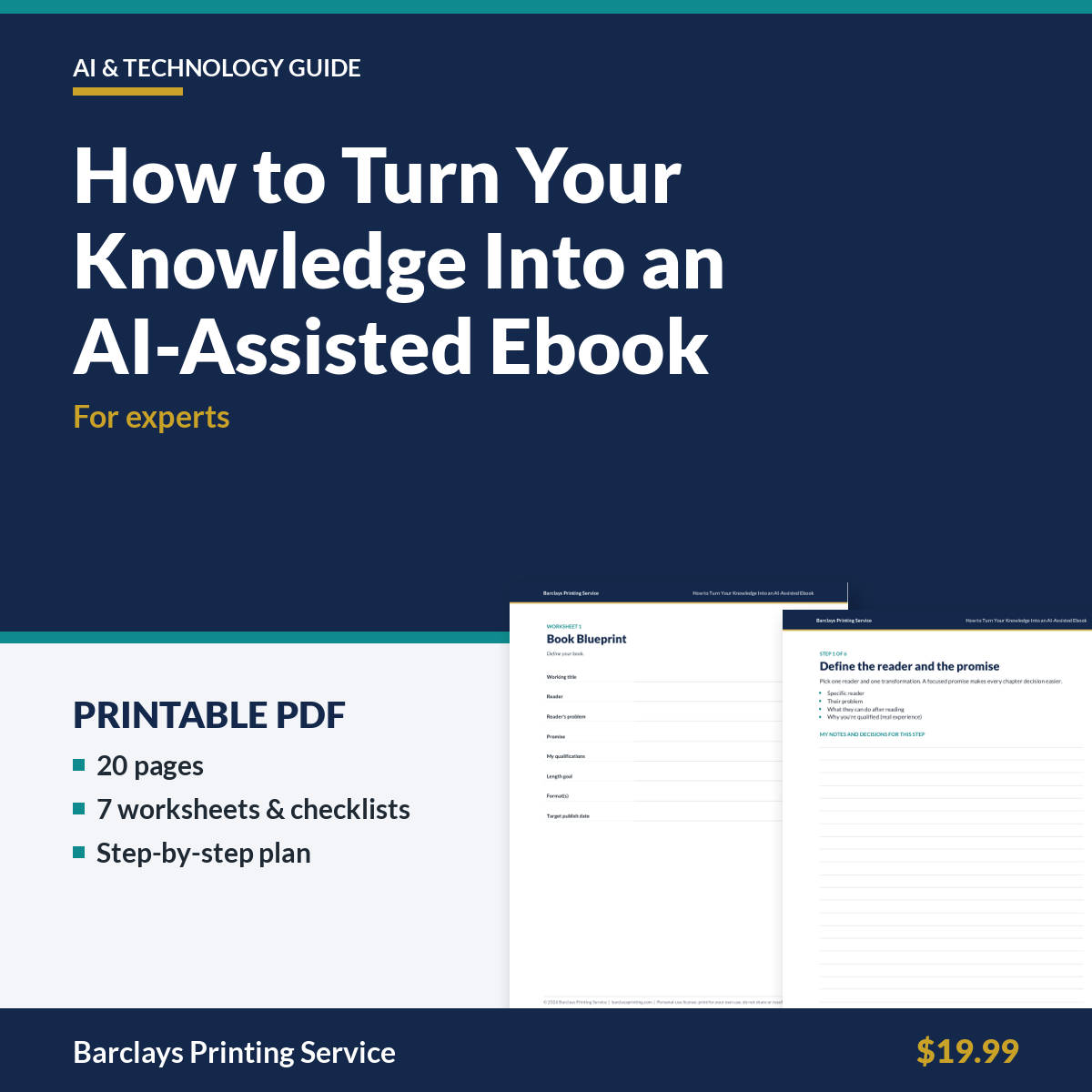
Our How to Turn Your Knowledge Into an AI-Assisted Ebook guide is a 20-page printable PDF for experts, priced at $19.99. It includes a Book Blueprint, a Knowledge Capture Log, a Chapter Outline, a Drafting Tracker, a Voice and Prompt Guide, a Publishing Checklist and a Launch Plan, plus a personal action plan. It’s an instant digital download you can print and fill in as you write your book. Results depend on your own situation and effort; no specific outcome is promised.